
This abstract received an Honorable Mention at the 2026 Mississippi Academy of Science conference and the Millsaps Undergraduate Scholars Symposium, where it was presented as a poster. This abstract is part of an essay from the 24Fall-Phil3302-O001 class on Aristotle, taught by Prof. Dr. Benjamin James Aguda.
If you want to read the essay, email me at slboaven@uno.edu, and I will share it with you.
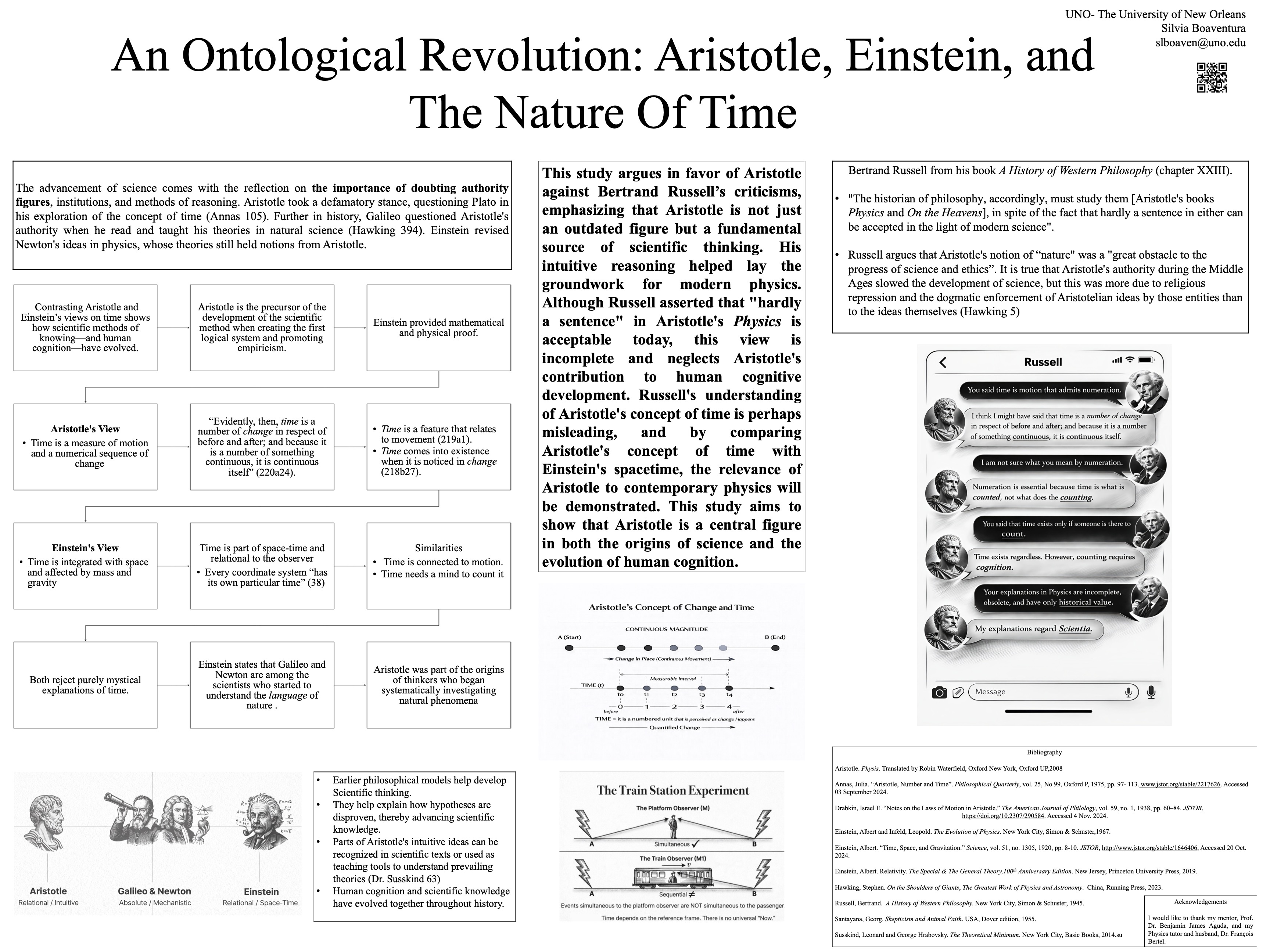
Abstract: This essay challenges Bertrand Russell’s claim, from his book A History of Western Philosophy (chapter XXIII), that barely a phrase from Aristotle’s notion of physics should be considered in science. I argue that his understanding of Aristotle’s concept of time is incomplete and possibly misleading. By comparing Aristotle’s idea of time with Einstein’s concept of space-time, it is possible to show that Aristotle remains relevant to physics. Aristotle’s simplistic perceptions and conceptions of existence and how natural phenomena function, even if they are proven false, allow us to perceive the ontological transformation and cognitive evolution that humankind undergoes as it evolves in its historical verve.
The most notable misunderstanding from Russell is to state that “Time, he [Aristotle] says, is motion that admits numeration.”(Russell 206). Russell understood that time stands for motion, a movement that enables calculation. Nevertheless, what Aristotle argues is that time is a type of number that counts motion in reference to before and after (Annas 97). Aristotle suggests that time is a feature of movement (219a1). Time is a numbered unit we perceive as change occurs, and it comes into existence when it is noticed in change.
By comparing Einstein’s sophisticated concept of time from space-time with Aristotle’s first perception, it is possible to note similarities. To them, time is a measure of the duration of motion, and an observer is needed to count it. Furthermore, history shows that Aristotle conceived time as relational to the observer; later, Galileo and Newton claimed that time was absolute and independent of the observer. Today, modern science holds that time is relational, linked to space and mass, forming a unified entity known as space-time.
The advancement of science comes with the reflection on the importance of doubting authority figures, institutions, and methods of reasoning. Aristotle took a defamatory stance, questioning Plato in his exploration of the concept of time(Annas 105). Further in history, Galileo questioned Aristotle’s authority when he read and taught his theories in natural science (Hawking 394). Einstein revised Newton’s ideas in physics, whose theories still held notions from Aristotle. Parts of Aristotle’s intuitive ideas can be recognized in scientific texts or used as teaching tools to understand prevailing theories (Dr. Susskind 63). Science benefits more from studying Aristotle’s notions of physics than from ignoring them. It helps understand how his hypotheses were disproven, leading to the evolution of scientific knowledge.
Einstein states that Galileo and Newton are among the scientists who began to understand the language of nature. Aristotle was part of the origins of thinkers who began systematically investigating natural phenomena. I share Russell’s opinion that philosophers studying history must examine Aristotle’s ideas of physics (Russell 203). However, I believe their importance extends beyond that, given their core role in science. Rejecting or overlooking the relevance of Aristotle’s ideas in physics is like erasing a part of the origins of science. His notions are pertinent to the evolution of modern science and significant to the analysis of how society develops intellectually.
Bibliography
Aristotle.Physis. Translated by Robin Waterfield, Oxford, New York, Oxford UP,2008
Annas, Julia. “Aristotle, Number and Time”. Philosophical Quarterly, vol. 25, No 99, Oxford P, 1975, pp. 97- 113.www.jstor.org/stable/2217626. Accessed 03 September 2024.
Einstein, Albert and Infeld, Leopold. The Evolution of Physics. New York City, Simon & Schuster,1967.
Einstein, Albert. “Time, Space, and Gravitation.” Science, vol. 51, no. 1305, 1920, pp. 8-10. JSTOR, http://www.jstor.org/stable/1646406, Accessed 20 Oct. 2024.
Einstein, Albert. Relativity. The Special & The General Theory,100th Anniversary Edition. New Jersey, Princeton University Press, 2019.
Hawking, Stephen. On the Shoulders of Giants, The Greatest Work of Physics and Astronomy. China, Running Press, 2023.
Russell, Bertrand. A History of Western Philosophy. New York City, Simon & Schuster, 1945.
Susskind, Leonard and George Hrabovsky. The Theoretical Minimum. New York City, Basic Books, 2014.
 Silvia Boaventura
Leave a comment